
Most eBay sellers approach listing optimisation the same way: they ask ChatGPT to “write a better title,” copy a few keywords from competitors, and hope for the best. The results? Mediocre at best. Generic AI tools have no access to real-time search volume data, eBay's marketplace dynamics, or competitor pricing — they're guessing in the dark.
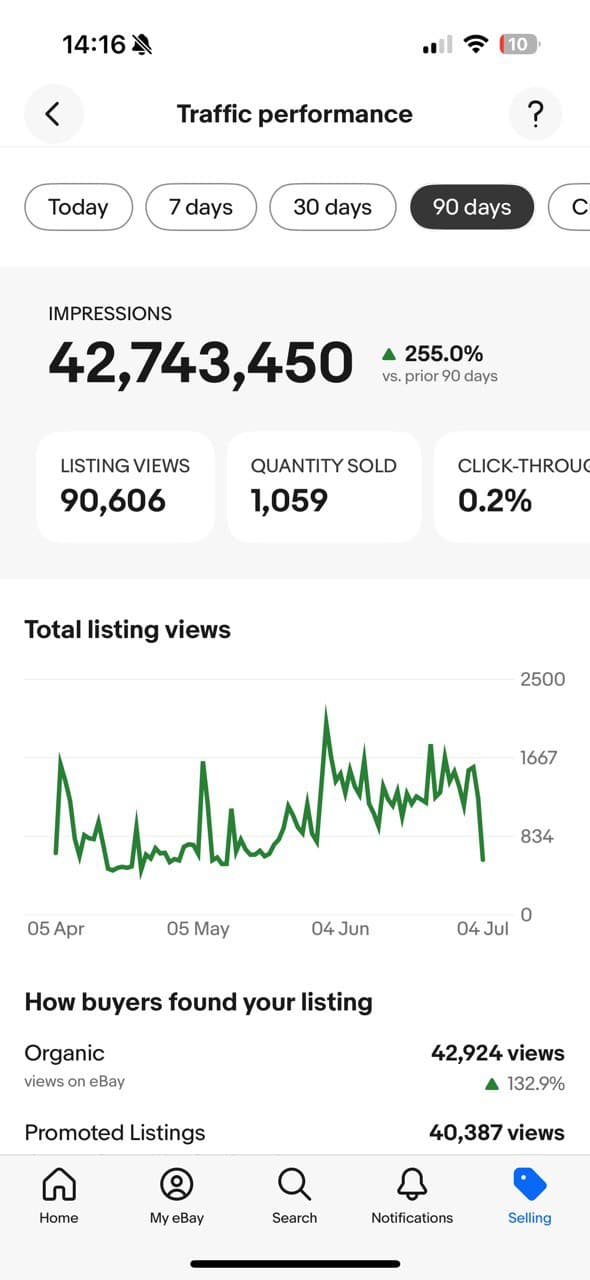
This guide reveals a fundamentally different approach: a multi-API data pipeline that queries 12+ sources per listing, generating optimised titles, item specifics, and keyword strategies backed by real data. For one anonymised seller, the seller-supplied screenshots show 718% more impressions over 30 days and 133% more organic views over 90 days, each against the previous period. Read the full case study.
Whether you sell 10 listings or 10,000, this is how professional eBay listing optimisation actually works in 2026.
Why Generic AI Fails for eBay Optimisation
Large language models are impressive for general text generation. But eBay listing optimisation requires something they fundamentally lack: real-time marketplace data.
When you ask a chatbot to “optimise my eBay title,” it generates plausible-sounding text based on patterns in its training data. It doesn't know:
- What buyers are actually searching for right now
- Which keywords have high search volume but low competition
- What your competitors are pricing similar items at today
- How eBay's search algorithm weights different ranking factors
- Seasonal demand shifts that affect keyword relevance
How the Multi-API Data Pipeline Works
Our e-commerce optimisation system takes a fundamentally different approach. Instead of generating text from training data, it queries 12+ live data sources for every single listing, building a complete picture of the marketplace before generating anything.
Multi-API Data Pipeline: 12+ Sources Per Listing
Cross-references data, scores keywords, generates optimised titles & item specifics
Data Sources Explained
Search & keyword APIs (DataForSEO, Google Search API, Keywords Everywhere) provide real search volumes, competition scores, cost-per-click data, and autocomplete suggestions. This tells us exactly what buyers type when looking for your product.
Marketplace APIs (eBay API, Amazon API) reveal competitor listings, pricing data, sold item history, and category-specific item specifics. We see what's selling, at what price, and with what titles.
Supplementary databases (scientific and product databases) provide accurate technical specifications — materials, dimensions, compatibility data — that most sellers leave blank in their item specifics.
The 4-Step Optimisation Process
Every listing goes through a systematic pipeline that mirrors how professional SEO agencies work — but automated and at scale.
The 4-Step Optimisation Process
Extract
Import existing listings, extract product attributes, identify gaps in item specifics and keywords.
Research
Query 12+ APIs for keyword data, competitor analysis, search volumes, and market trends.
Generate
Create 15 title variations, score algorithmically, auto-populate 45+ item specifications.
Monitor
24/7 automated refresh cycles. Track performance, adjust keywords, catch seasonal trends.
Step 1: Extract & Analyse
The system imports your existing listing and extracts every data point: current title, item specifics, description content, pricing, and category placement. It identifies gaps — missing item specifics, underused character limits, keyword opportunities your current title misses entirely.
Step 2: Multi-Source Research
This is where the magic happens. For a single product, the system might query:
- 200+ autocomplete suggestions from eBay and Google
- Search volumes for 50+ candidate keywords
- Top 20 competitor listings for title patterns
- Cross-platform pricing data from multiple marketplaces
- Category-specific item specifics that drive search visibility
Step 3: AI-Enhanced Generation
With real data in hand, the AI generates 15 title variations, each scored against search volume, competition, character efficiency, and keyword diversity. The winning title isn't chosen by feel — it's selected by algorithm.
Simultaneously, the system auto-populates 45+ item specifics from product data and database lookups. On eBay, filled item specifics directly influence search visibility — yet most sellers complete fewer than 10.
Step 4: Continuous Monitoring
Unlike a one-time optimisation, the system runs 24/7 refresh cycles. It monitors performance metrics, detects when keywords lose effectiveness, spots seasonal trends, and automatically adjusts. Your listings stay optimised even as the marketplace shifts.
Understanding eBay's Cassini Search Algorithm
eBay's search engine, Cassini, determines which listings appear when buyers search. Unlike Google, Cassini is a marketplace algorithm — it doesn't just match keywords, it predicts which listings are most likely to result in a sale.
What Cassini Rewards
- Relevant, keyword-rich titles that match buyer search queries
- Complete item specifics — the more filled fields, the better visibility
- Competitive pricing relative to similar active listings
- Strong seller metrics (shipping speed, return rate, feedback score)
- Listing freshness — recently revised listings get a temporary boost
- Sales velocity — listings that sell well get promoted in search
This is why the multi-API approach is so effective: it addresses every Cassini ranking factor simultaneously. Keywords from real search data, complete item specifics from product databases, competitive pricing from marketplace APIs, and ongoing freshness from automated refresh cycles.
Results From One Anonymised Seller
Here are eBay Seller Hub screenshots supplied by one anonymised seller using API-powered optimisation. They come from the seller's own eBay reporting, not our projections, but we have not independently verified them. See the eBay optimiser case study for the full write-up.
Results for one anonymised eBay seller
From seller-supplied eBay Seller Hub screenshots, each period compared with the one before it. Not independently verified.
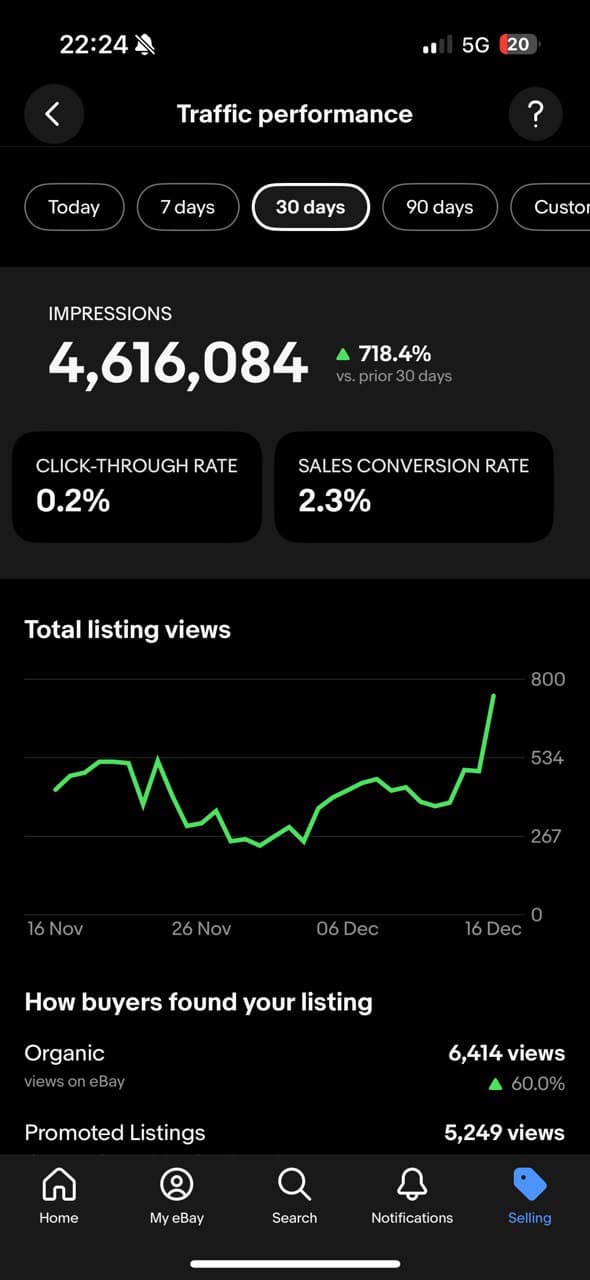
Over 30 days against the previous 30, the screenshots show a 718.4% increase in impressions and 60% growth in organic views. Impressions measure how often your listings appear in search results — a direct indicator of keyword relevance and Cassini ranking.
Over 90 days against the previous 90, the screenshots show 42.7 million impressions, 132.9% organic view growth, and 1,059 units sold. This is one store, so treat it as an example rather than a typical result. The system continuously optimises, and each sale further improves Cassini ranking through sales velocity signals.
API-Powered vs ChatGPT vs Manual: A Direct Comparison
To understand the value proposition clearly, let's compare the three approaches sellers typically use for e-commerce optimisation.
API-Powered vs ChatGPT vs Manual Optimisation
| Feature | API-Powered | ChatGPT | Manual |
|---|---|---|---|
| Keyword research | Real search volume data from 12+ sources | Guesses based on training data | Hours of spreadsheet work |
| Title optimisation | 15 variations scored algorithmically | 1-3 generic suggestions | Trial and error |
| Item specifics | 45+ auto-populated from product data | Basic suggestions only | Copy from competitors |
| Competitor analysis | Live pricing & keyword monitoring | No live data access | Spot checks, quickly outdated |
| Ongoing optimisation | 24/7 automated refresh cycles | One-time output | Rarely revisited |
The difference isn't just speed — it's data quality. Manual optimisation relies on intuition. ChatGPT relies on training data that's months or years old. API-powered optimisation uses live marketplace data, updated in real time.
How Market Monitoring Catches What You Miss
E-commerce markets shift constantly. A keyword that drives traffic in January may be irrelevant by March. A competitor drops their price by 20%, and suddenly your listing disappears from search results. Without monitoring, you're always reacting — never anticipating.
Example: 24/7 Market Monitoring Dashboard
Illustrative mock-up with example figures.
Seasonal Trend Detection
The system tracks search volume patterns across time, identifying seasonal demand shifts weeks before they peak. When searches for “garden furniture” start climbing in February, your listings are already optimised with spring keywords before competitors notice the trend.
Competitor Price Tracking
Cassini factors in pricing competitiveness. When competitors adjust prices, the system detects it and alerts you — or automatically adjusts your pricing strategy to maintain visibility. No more losing the Buy It Now box because a competitor undercut you overnight.
Keyword Performance Decay
Keywords lose effectiveness over time as market conditions change. The monitoring system detects declining click-through rates on specific keywords and triggers a re-optimisation cycle, swapping underperforming terms for trending alternatives.
Scaling from 10 to 10,000 Listings
Here's where the economics become compelling. Manual optimisation doesn't scale — the time cost grows linearly with listing count. Our workflow automation approach changes the equation entirely.
Example Time Savings Calculator
An estimate from the stated assumptions (3 hours per listing by hand, about 2 minutes of automated processing). Your figures will differ.
At 10 listings, manual optimisation is painful but possible — 30 hours of work. At 100 listings, it's a full-time job. At 1,000 listings, it's physically impossible for a single person. At 10,000, you'd need an entire team.
An automated system can work through a large catalogue without that time cost growing in the same way. And because it runs continuously, every listing stays optimised — not just the ones you had time to update this month.
Putting It All Together
The power of this system isn't any single component — it's how they work together. Real keyword data feeds into AI content generation. Generated listings are monitored for performance. Performance data feeds back into the next optimisation cycle. It's a closed-loop system that gets smarter with every iteration.
For sellers serious about growing their eBay business, this represents a genuine competitive advantage. While others are copying competitor titles and hoping for the best, you're operating with data-driven precision at any scale.
Ready to Transform Your eBay Listings?
See how API-powered optimisation can work for your specific product catalogue.